What Sundar Pichai’s latest interview signals about Google Search, AI Mode, publishers, and the next phase of SEO.
Sundar Pichai’s interview with John Collison and Elad Gil: search becoming more agentic, Google’s internal use of Antigravity, a robotics acceleration, the rise of persistent AI systems, and Pichai’s view that 2027 could be an inflection point. This version takes those themes and turns them into a broader reported feature for SEO readers, using Google’s own product announcements, DeepMind and Wing updates, and third-party research on search behavior and publisher traffic.
The biggest signal in the interview was not a product launch. It was a redefinition of search.
In the interview transcript, Pichai did not describe search as a shrinking legacy business. He described it as something that “keeps evolving,” adding that many information-seeking queries will become agentic and that Search could become an “agent manager” handling multiple tasks and threads. That is a major framing shift. It suggests Google no longer sees the future of search as a page that simply ranks documents, but as a system that can coordinate actions, workflows, and decisions across time.
That framing lines up closely with what Google has already been shipping. In March 2025, Google introduced experimental AI Mode as a more end-to-end AI search experience. By May 2025, Google said AI Overviews had scaled to more than 1.5 billion users in 200 countries and territories, and that in markets like the U.S. and India they were driving more than 10% query growth on searches where they appear. In March 2026, Search Live expanded globally anywhere AI Mode is available, and in April 2026 Google brought AI Mode more deeply into Chrome so users could ask questions while browsing without switching tabs. The product road map already looks like the bridge between classic search and the agentic future Pichai described.
For SEOs, that matters because it changes the unit of competition. In the old model, the battle was often page versus page. In the emerging model, the battle is increasingly answer versus answer, workflow versus workflow, and trusted entity versus generic source. That is not the end of SEO, but it is the end of treating rankings as the whole game. This is an inference from Google’s product direction and from Pichai’s own description of Search as an agentic system rather than a static retrieval engine.
AI Mode is not a side feature. It is Google teaching users a new search habit.
One of the most revealing details in the transcript is that Pichai pointed to current user behavior inside AI Mode as evidence that people will adapt. He said people already do deep research queries there, even though that behavior does not fit the old one-line-query model. Google’s own launches reinforce that idea: AI Mode has been positioned as a more conversational, multimodal, follow-up-friendly search experience, and Search Live adds voice and camera interactions on top.
That is important because major shifts in search rarely happen all at once. Google usually trains users gradually. Featured snippets trained users to accept answers on the results page. AI Overviews trained users to accept synthesized answers from multiple sources. AI Mode trains users to stay inside a conversation and refine intent through follow-ups. Chrome integration trains them to use Google while they are already on a webpage. Each step reduces the distance between “searching” and “delegating.” That reading is interpretive, but it is grounded in the sequence of Google’s product releases.
A Reuters report from March 2025 captured the structural implication early: with AI Mode, users get a more comprehensive AI summary with hyperlinks, and the familiar “10 blue links” are replaced by a follow-up search box. That is not a cosmetic UI tweak. It changes how attention flows through the SERP.
Inside Google, the “agent manager” model is already changing work.
Pichai’s comments about Antigravity may be the most underappreciated SEO signal in the whole conversation. In the transcript, he said he uses Antigravity internally to quickly surface the best and worst reactions to launches, and he said some Google DeepMind and software engineering groups are already working in that “agent manager world.” He also said the Search team had just been rolled onto it. Internally, the product is called “Jet Ski.”
This matters for two reasons. First, it suggests the people building Search are themselves shifting toward agent-assisted workflows. Second, it implies that Google’s public product vision is being informed by internal operational change, not just market pressure. When the builders live inside agentic systems, they are more likely to design search for agentic behavior.
Recent reporting adds more weight to that interpretation. Reuters reported on April 22, 2026 that Google is putting AI agents at the center of its enterprise push, adding governance and security features for agents and framing them as a core monetization path. The same report said Pichai noted that 75% of new code at Google is now generated by AI, up from 50% the previous fall. That does not prove consumer Search will instantly become autonomous, but it does show that Google’s internal and enterprise posture is moving hard toward agentic execution.
The robotics discussion was not a tangent. It revealed how Google thinks about AI in the real world.
At first glance, the interview’s detour into robotics, Waymo, hardware, and drone delivery might seem peripheral to SEO readers. It is not. Pichai’s point was that AI becomes more powerful when it is connected to real tasks, real safety systems, and real feedback loops. In the transcript, he said Wing is being scaled so that 40 million Americans could have access to Wing delivery service in a reasonable time frame. Wing’s own January 2026 announcement confirms an expansion to 150 additional Walmart stores, a path to more than 40 million Americans, and over 270 drone delivery locations in 2027. Wing also says it has safely completed more than 750,000 deliveries and now covers more than two million customers across major U.S. metros.
DeepMind’s robotics work tells a similar story. In March 2025, Google DeepMind said Gemini Robotics-ER could handle perception, state estimation, spatial understanding, planning, and code generation, achieving a 2x–3x success rate compared with Gemini 2.0 in an end-to-end robotics setting. That is relevant because the interview’s core theme is not “chatbots that answer.” It is systems that perceive, plan, and act.
For search marketers, the lesson is that Google increasingly appears to view intelligence as something that should move from passive retrieval into active execution. Shopping, travel, research, productivity, browsing, and even robotics all point in the same direction: AI that helps complete the job. The SEO implication is that pages built only to win informational clicks may lose ground to pages, tools, datasets, and brands that help an agent finish a task. That is an inference, but it follows from the capabilities Google is emphasizing across products.
Pichai’s “2027” comment may be the most important forecasting clue in the interview.
In the transcript, when asked about fully agentic forecasting with no human in the loop, Pichai said he expects 2027 to be “an important inflection point” and “a big year” for certain shifts. Marie Haynes highlighted that as one of her five biggest takeaways, and she was right to do so. Even if the exact timeline slips, the significance is not the date itself. It is that Pichai publicly framed a crossover from human-led workflows to AI-led workflows as plausible in the near term.
Google’s April 2026 Deep Research update makes that forecast feel less speculative. Google says Deep Research and Deep Research Max are autonomous research agents that can search the web, work with file uploads and connected file stores, and generate presentation-ready charts and infographics. It also says this same infrastructure powers research capabilities inside Gemini, NotebookLM, Google Search, and Google Finance. In other words, the “long-running tasks” idea Pichai described is already being productized.
The likely interpretation is that 2026 is the year of product scaffolding, while 2027 may be the year those scaffolds become normalized in everyday work. That is still an interpretation, not a confirmed roadmap. But it fits both the transcript and Google’s current launch cadence.
The SEO story here is not just about Google. It is about shrinking clicks and rising synthesis.
Third-party data shows why this matters beyond product theory. Semrush’s 2025 study of more than 10 million keywords found that AI Overviews grew rapidly during 2025 and settled at about 15.69% of all queries by November. The same research found expansion beyond informational queries into commercial, transactional, and navigational intent. Commercial queries rose from 8.15% to 18.57%, transactional from 1.98% to 13.94%, and navigational from 0.84% to 10.33%. That means the effect is moving closer to revenue-driving search behavior, not staying confined to top-of-funnel queries.
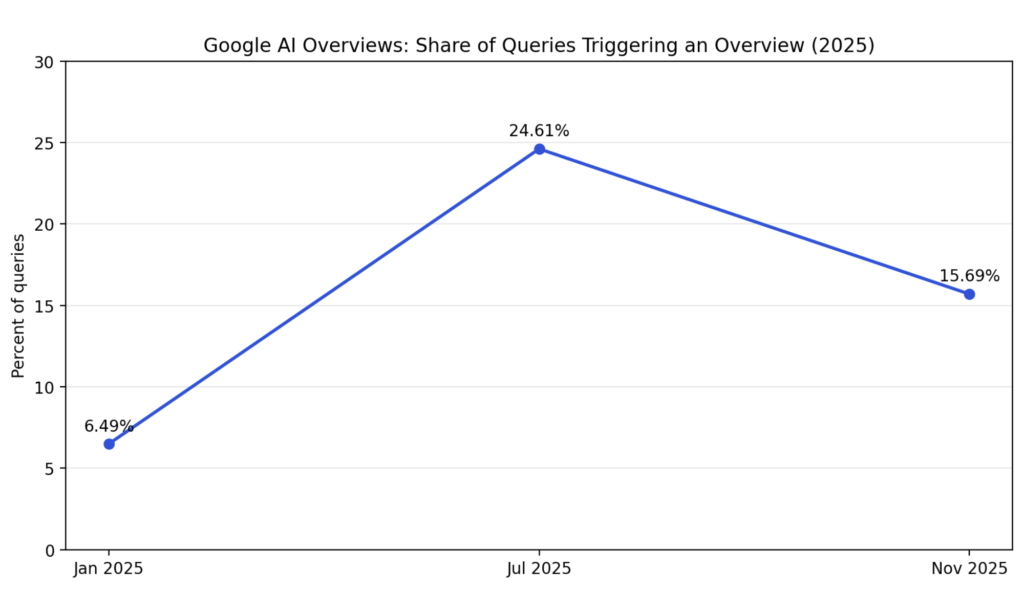
Semrush’s summary is blunt: AI Overviews are turning Google into both a search engine and an answer engine. That phrasing matches the broader shift Pichai hinted at in the interview. Search is evolving from retrieval toward orchestration and synthesis.
At the same time, Similarweb reported that AI platforms generated more than 1.1 billion referral visits in June 2025, up 357% year over year, and that referrals to transactional sites were converting at around 7%. So the story is not simply “traffic disappears.” Part of it is being redistributed into new interfaces and potentially higher-intent visits.
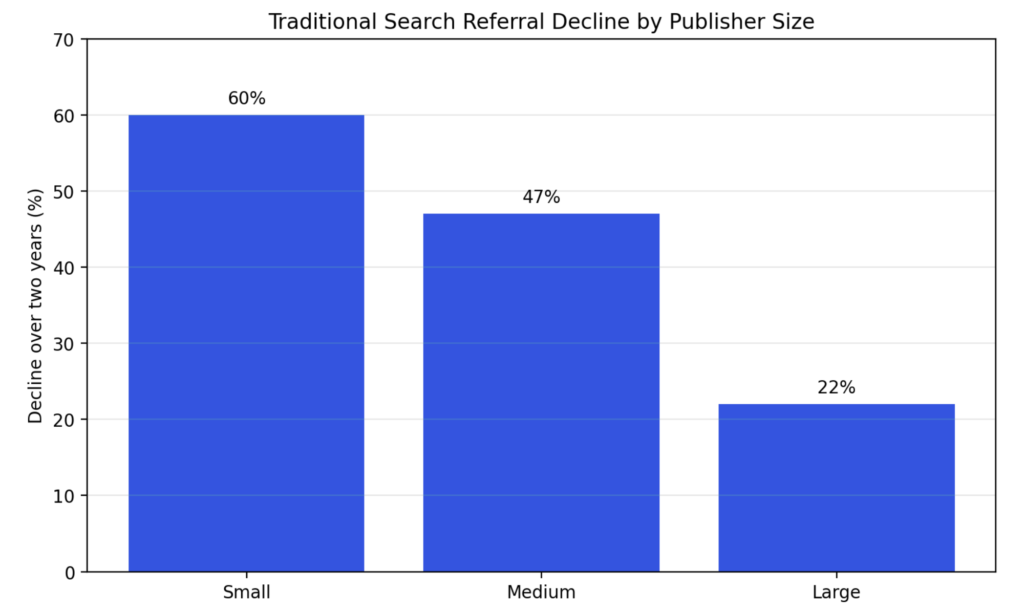
But publisher-side evidence shows the transition is painful. Reuters Institute’s 2026 trends report said publishers fear search traffic could fall 43% over the next three years, and The Guardian’s coverage of that report said Google search traffic to news sites was already down 33% globally. Axios, citing Chartbeat data, reported in March 2026 that traditional search referral traffic had fallen 60% for small publishers over two years, 47% for medium publishers, and 22% for large ones. It also reported that Google Search and Discover page views fell 34% and 15%, respectively, from December 2024 to December 2025, while chatbot referrals still accounted for less than 1% of total publisher page-view referrals.
That explains why publisher tension is rising. Reuters reported in July 2025 that Google faced an EU antitrust complaint over AI Overviews from independent publishers alleging irreparable harm. Whatever one thinks about the legal merits, the conflict itself shows how consequential these search changes are becoming.
So what does this mean for SEO now?
The first implication is that citation-worthiness matters more. In answer-heavy environments, the winning page is not always the one that attracts the click. It may be the one that earns the mention, the citation, the fact extraction, or the brand recall inside an AI-generated answer. That means first-hand reporting, proprietary data, expert interpretation, clear structure, and strong entity signals become even more important. This is an inference supported by Google’s answer-centric product shift and by publisher traffic data showing the SERP is holding more of the interaction.
The second implication is that keyword targeting alone is too narrow. If search is becoming better at handling multi-step intent, then pages should be designed around complete jobs: compare, choose, plan, calculate, shortlist, decide, and act. The pages most likely to survive the shift are the ones that can help an AI system or a human finish something, not just learn something. Again, this is an interpretation grounded in Pichai’s “agent manager” framing and Google’s rollout of AI Mode, Search Live, and Deep Research.
The third implication is that brand strength becomes even more valuable. Axios’ Chartbeat-based reporting suggests larger publishers are more insulated than small ones, likely because they have stronger direct traffic, recognition, and diversified channels. In an AI-mediated web, that pattern is likely to extend beyond journalism. When users do fewer exploratory clicks, remembered brands and trusted names gain relative advantage.
The fourth implication is that SEO measurement has to widen. Rankings, sessions, and clicks still matter, but they no longer tell the whole story. Teams should also care about branded search lift, inclusion in AI summaries, cited-source frequency, assisted conversions, direct traffic, newsletter growth, return visits, and whether their content is being used as the source layer for machine-generated answers. That recommendation is a strategic inference from the evidence above, especially the mismatch between declining traditional search referrals and growing AI-mediated discovery.
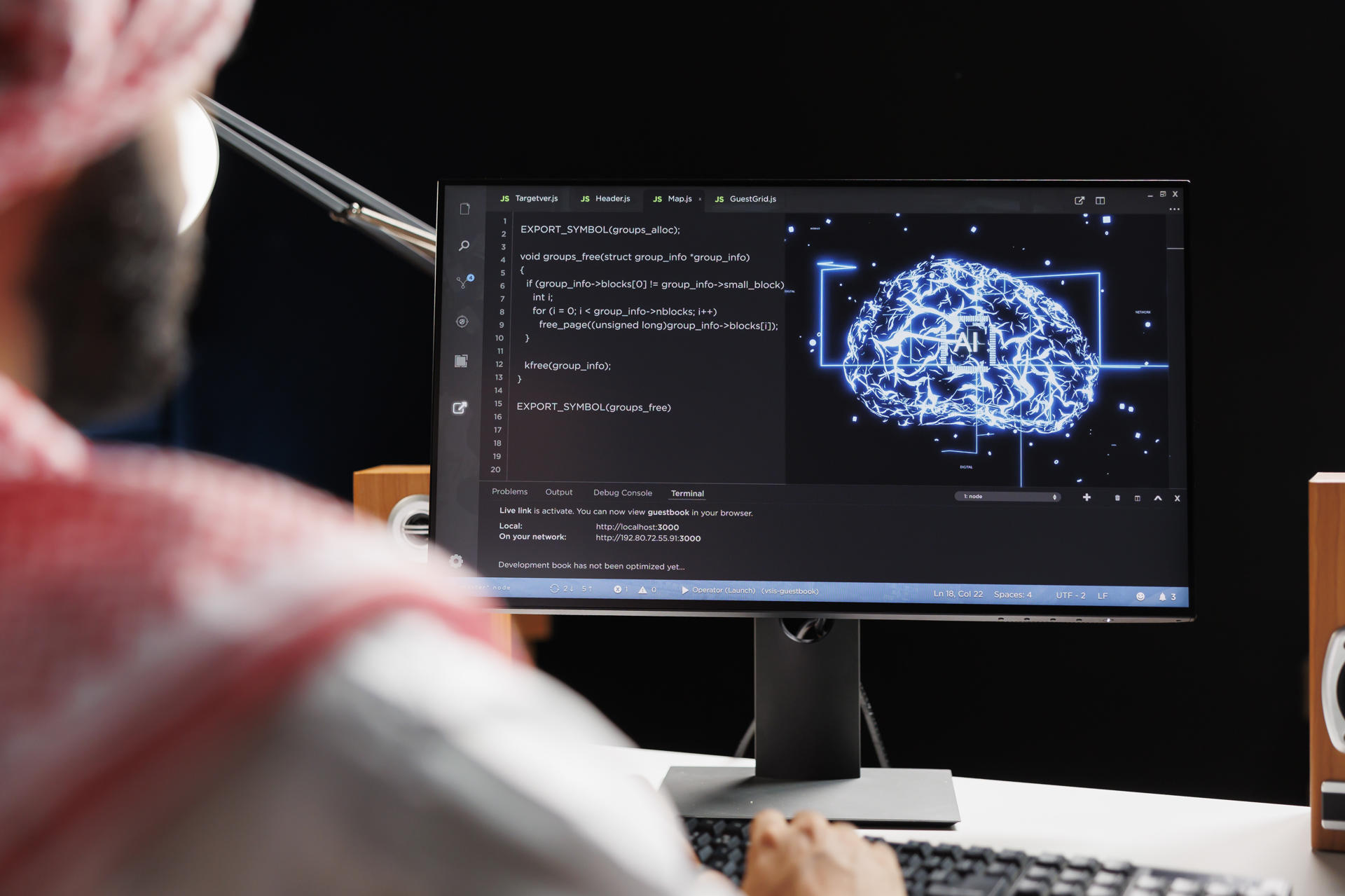
The real opportunity is not to “beat AI.” It is to become the material AI prefers to use.
This is where many SEO discussions go wrong. They frame AI search as a fight between websites and machines. But machines still need source material, evidence, entities, product information, opinions, benchmarks, reviews, and original reporting. The web does not disappear from that equation. Its role changes. In an agentic search world, your content may be read before it is clicked, summarized before it is visited, and evaluated for reliability before a user ever sees your page.
That makes the content moat clearer, not fuzzier. Brands should publish what generic model output cannot easily invent: original research, named experts, test results, local knowledge, product details, customer proof, proprietary comparisons, and strong point of view. If a future search agent is deciding what to cite, recommend, or use to complete a task, that is the kind of material most likely to survive the compression of clicks. This is analysis, but it is strongly supported by the trend toward synthesis and by the declining value of commodity content in traffic-heavy SERPs.
Final takeaway
If Pichai is right, then the future of search will not be defined by whether links survive. Links will survive. Websites will survive. SEO will survive. But the primary interface between user and information is changing from retrieval to delegation. Search is being rebuilt as a system that helps people complete work, not just discover pages.
For SEO teams, that means the playbook expands. You still need crawlability, relevance, internal links, technical health, and strong content. But you also need to become easy to cite, easy to trust, easy to synthesize, and useful inside agentic workflows. That is the real message inside this interview, and it is why this conversation deserves attention well beyond the AI hype cycle.
- Recent Feed

Join with Us
Subscribe to
Search Feed
Receive daily updates & news from the world of Search. Be at the forefront of happenings and the first of few to act to the changing dynamics of search.
- No Spamming
- Safe Data

Home
- Vision & Mission
- Vision & Mission
- Vision & Mission
- Vision & Mission
About us
- Vision & Mission
- Vision & Mission
- Vision & Mission
- Vision & Mission
Solutions
- Vision & Mission
- Vision & Mission
- Vision & Mission
- Vision & Mission
Contact us
- Vision & Mission
- Vision & Mission
- Vision & Mission
- Vision & Mission
Copyright @SearchCMD 2026