With hotel price tracking, AI Mode travel planning, restaurant booking, and AI-powered calling to local stores, Google is pushing Search further beyond answers and deeper into action.
Google’s latest Search updates may look, at first glance, like a bundle of travel conveniences timed for summer. But taken together, they point to something much larger: Google is steadily turning Search from a place that helps users find information into a system that helps them complete tasks. That distinction matters, because it changes what ranking, discovery, and user journeys may look like in the AI era.
The immediate announcement centers on seven travel-related capabilities, including custom trip planning in AI Mode, hotel-level price tracking, restaurant booking assistance, AI-powered calls to nearby stores, translation help, Maps recommendations for road trips, and Google Wallet tools for airports. Search Engine Journal highlighted three of those updates in particular, but Google’s own announcement makes clear that the company sees them as part of a broader Search product direction, not just isolated travel utilities.
That broader direction is what matters most for SEOs. Google is no longer merely refining how it retrieves pages. It is redesigning Search around workflows: research, comparison, planning, contacting businesses, booking, and eventually purchasing. In other words, Google is building an interface for intent completion.
The headline update: Search is getting more task-oriented
The clearest example in this rollout is AI Mode’s Canvas tool for travel planning. Google says users can open AI Mode, choose Canvas, describe an ideal trip, and receive a structured itinerary in a side panel that includes flights, hotels, attractions, and a mapped layout. Users can then keep refining that plan with follow-up prompts, while AI Mode saves progress in history. Google says this Canvas-based travel planning is now available to everyone in the U.S.
On its own, Canvas is a useful feature. Strategically, though, it is even more important as a signal. Search is no longer just returning a set of blue links and hoping the user can stitch them together. It is assembling a workspace, holding state across steps, and helping the user move from research to execution. That is exactly the kind of product behavior SEOs should read as a shift in how discovery will happen inside Google over the next few years. This interpretation is also consistent with Google’s earlier description of AI Mode as an end-to-end AI search experience built for deeper reasoning, multimodality, and follow-up interaction.
Google’s own language supports that framing. At I/O 2025, the company described AI Mode as going “beyond information to intelligence,” explaining that it uses a query fan-out technique to break complex questions into subtopics and issue many searches simultaneously on a user’s behalf. That means the user increasingly experiences Search not as a page of results, but as an active assistant that decomposes work and returns synthesized outcomes.
Hotel price tracking gets more specific and more useful
The most immediately practical feature in the new announcement is individual hotel price tracking. Previously, Google allowed users to track hotel prices at the city level. Now it also lets people track price changes for a specific hotel listing. On desktop, users can search for a hotel and turn on a new price-tracking toggle. On mobile, the feature appears under the Prices tab. Google says it will send email alerts when rates change significantly for the selected stay dates. It is also available through Google Hotels, and Google says the feature is rolling out globally for signed-in users in English and Spanish.
This may sound incremental, but it pushes Search one step closer to a transactional monitoring layer. Instead of helping users compare hotels in a single moment, Google can now stay involved over time, watch for changes, and re-enter the journey when the economics shift. That is sticky product design. It increases the chances that the user returns to Google, not a third-party OTA or travel metasearch platform, when it is time to book.
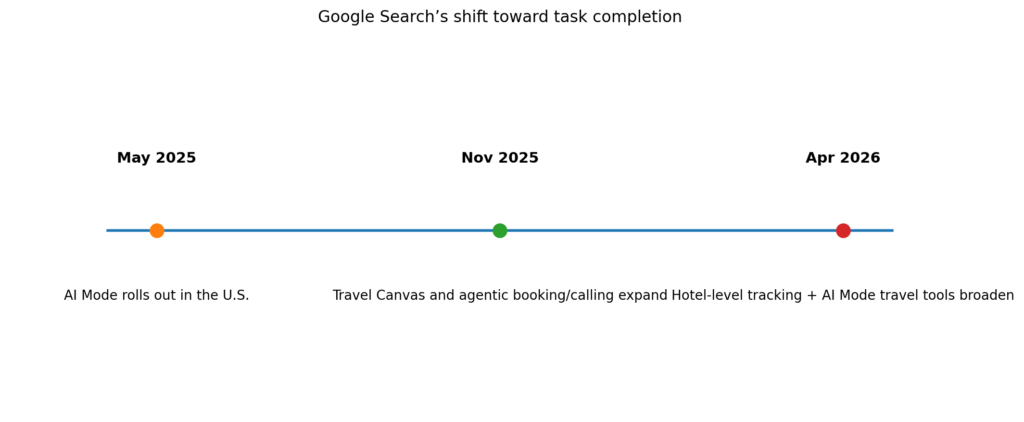
It is also notable that this is part of a longer travel-commerce buildout. In November 2025, Google had already introduced Canvas for travel planning and detailed plans for agentic booking around restaurants, flights, and hotels, working with partners such as Booking.com, Expedia, Marriott, Wyndham, Choice, and IHG. The new hotel-tracking update extends that same arc: compare, monitor, decide, act.
AI Mode is learning to contact the real world
Another key update is AI-powered calling for nearby stores. Google says that when users search for certain products “near me,” AI Mode can now call local stores directly to ask whether the item is in stock and surface any relevant deal information. The feature, powered by Gemini models and Duplex technology, had already launched in Search in late 2025 and is now rolling out into AI Mode in the U.S. over the coming weeks.
This matters because it shows Google crossing a line that traditional search never crossed cleanly: interacting with off-web inventory through direct outreach. Search is no longer limited to indexing web pages and business listings. It can initiate calls, gather fresh data from the physical world, and summarize the answer back to the user. For local SEO, that has serious implications. Accurate business data, store staff readiness, local availability signals, and response consistency are becoming part of what “search optimization” may mean in practice.
It is also part of a wider pattern. Google has similarly expanded agentic restaurant booking, saying AI Mode and Ask Maps can search across reservation platforms and websites, then present available options with direct links to finalize reservations through partners such as OpenTable and Resy. Here again, Search is compressing steps that once required multiple apps, tabs, or phone calls.
The travel update is really a product strategy update
If you zoom out, the April 2026 announcement is less about “summer travel tips” than about interface strategy. Google is teaching Search to become a layered journey engine: discover, compare, plan, track, contact, and book. The updates appear travel-themed because travel is a perfect proving ground for multi-step intent, but the same architecture is already visible in shopping and local search.
Google’s shopping stack shows how serious that ambition is. The company says its Shopping Graph now contains more than 50 billion product listings, with more than 2 billion refreshed every hour. In AI Mode shopping, Google is already using that data to help users narrow options conversationally. It has also introduced agentic checkout ideas, where users can track a desired product and let Google complete checkout on the merchant site once a price target is met and the user confirms.
That matters for SEO because it suggests Google’s future commercial advantage will not come only from ranking results well. It will come from owning the connective tissue between intent and transaction. Search, Maps, Shopping Graph, Google Pay, Wallet, Duplex, and Gemini are becoming pieces of the same operating layer.
The scale behind this shift is enormous
This product shift is happening on top of an already massive Search ecosystem. Google says it sees more than 5 trillion searches each year, and that 15% of daily searches are entirely new. It also says Lens now handles more than 25 billion visual queries per month, with one in four visual searches carrying commercial intent. AI Overviews, meanwhile, reach 1.5 billion users every month in more than 100 countries, according to Google.
Those numbers matter because they show why Google is investing so aggressively in multimodal and AI-assisted search behavior. Users are already asking more complex questions in more formats, and Google is trying to keep those journeys inside its own surfaces. Reuters reported in 2025 that Google expanded AI Mode to U.S. users as part of a broader bid to defend and modernize its search business amid competitive pressure from AI-native alternatives.
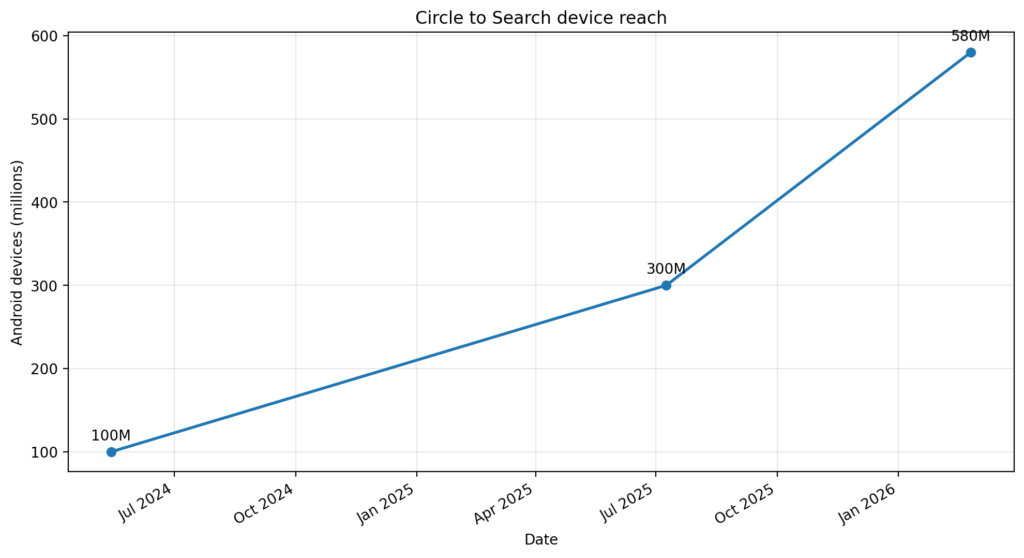
Google’s visual search products also show just how fast user behavior can shift once a new interface feels natural. Circle to Search was available on more than 100 million devices in May 2024, more than 300 million devices by July 2025, and more than 580 million Android devices by February 2026. That is a remarkable adoption curve for a search-adjacent behavior that barely existed in mainstream consumer workflows a short time ago.
The chart above illustrates that growth curve. For SEOs, the takeaway is straightforward: when Google finds a more convenient way to capture intent, users adopt it fast. And once those habits take hold, optimization shifts with them. Search success becomes less about a single rankings page and more about being structured, trusted, and usable inside a multi-step AI-mediated journey.
What this means for SEO teams right now
First, publishers and brands should expect more search journeys to begin and end inside Google’s own interfaces. The Verge recently reported that Google is also updating AI Mode in Chrome so users can open links side-by-side without leaving the AI experience, which further reduces friction in staying inside Google’s workflow. That kind of design choice is small on the surface but important strategically: it keeps the answer layer, source layer, and follow-up layer in one place.
Second, local SEO becomes more operational. If Google can call stores or gather reservation data, then local presence is no longer just about having the right NAP details and review profile. It also becomes about whether your business can respond clearly, consistently, and competitively when Google’s systems interact with it. Structured business information, current hours, inventory accuracy, booking links, and service clarity become even more valuable.
Third, commercial SEO should keep moving toward entity completeness, structured data, and feed quality. Google’s own materials repeatedly emphasize the scale and freshness of the Shopping Graph. That suggests brands that provide clean, current, machine-readable product information are better positioned for AI-mediated discovery than those relying only on traditional category-page optimization.
Fourth, content teams should think in workflows, not just keywords. If AI Mode is being designed to help users compare insurance, plan trips, find products, book restaurants, or source local inventory, then content that wins may be content that answers decision-stage questions clearly and credibly, not just content that matches informational phrases. Google’s own explanation of AI Mode’s query fan-out approach suggests that source usefulness in a synthesized environment depends on specificity, relevance, and trust signals.
Fifth, publishers should watch the traffic implications closely. Reuters reported last year that independent publishers in Europe had already raised antitrust concerns over AI Overviews, reflecting wider anxiety about what happens when Google summarizes more journeys before the click. Even when Google says AI users search more and visit a greater diversity of websites, the structural question remains: how much of the user journey stays within Google before that click happens, and which publishers benefit most when it does?
Why this update matters more than the headline suggests
The Search Engine Journal article was right to frame these features as part of a move toward task-based search. But the most important angle is not just that Google added a few new conveniences. It is that Google is operationalizing a new model of Search in public, one vertical at a time. Travel is the current showcase. Shopping, local commerce, and research workflows are close behind.
That means the familiar SEO question, “How do I rank for this query?” is slowly being joined by a harder one: “How does my brand show up, get trusted, and get chosen inside an AI-assisted task flow?” In many cases, the answer will depend on whether your data is accessible, your content is decision-useful, your business information is current, and your brand is present in the sources and platforms Google pulls into these workflows.
The deeper implication is simple. Search is becoming an action layer.
And for SEOs, that changes everything.